Why an Urban Ecotour?
The city of Delhi may have an outwardly grimy appearance, but beneath that layer of dust that blows in from the Thar, lie several layers of mystery, romance, and even – some say – magic! It is said about cities that if we listen carefully, a city speaks and narrates its story to all those who consider it their own. Delhi is no different and a rendezvous with the city reveals its glorious past and a heritage of green spaces, some of which were preserved even before the Mughals came to the city.
From the erstwhile Dehli to Khushwant Singh’s Bhagmati - the city of Delhi has attracted people from all walks of life. There’s something about Delhi that makes it more than just another large agglomeration of people in an urban area! The Urban Eco Tours project is a flagship project of Delhi Greens started with the intention of bringing the citizens of Delhi closer to the city itself.
Away from the blinding lights of the malls that seem to have taken over the facade of the city for the moment, lives another Delhi – of crumbling heritage trying to maintain its foothold in the sands of time, of lakes and landfills existing together, and of hidden history in the heart of the bustling metropolis.
Intended as a day-long date with some lesser known landmarks and occurrences in the city, the Delhi Greens Urban Eco-tour is an attempt to inculcate in the citizens of Delhi a sense of ownership and belonging. It seeks to highlight the issues that Delhi faces, discuss the possible solutions that exist now or could exist in the future, and how all of us – in our capacities as citizens and individuals can implement these solutions. We hope to ask our ‘tourists’ the question ‘kiski Dilli?’ We hope the answer will always be ‘meri Dilli’.
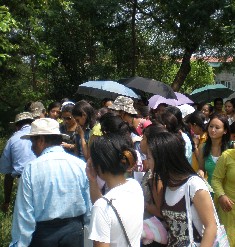
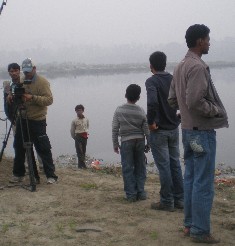
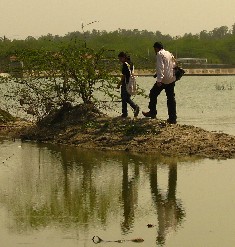
North City Ecotour
The Delhi Greens Urban Eco-Tour (North) starts from the Vishwavidyalaya (Delhi University) Metro Station. The journey starts with an introduction of Delhi, a talk on the Metro and the cycle stall at the Metro Station.
The Bus Tour then starts its journey to the Bhalswa Landfill and Lake Complex. Located on the GT Karnal Road, the Bhalswa Lake Complex, with the landfill in its vicinity is slated to be a 92-hectare recreational center for the entire family. The Bhalswa landfill is now a series of small hills composed entirely of garbage and waste. Like the other two landfills in Delhi, Bhalswa is also overflowing and with the increasing population and changing lifestyles, the problem only stands to get worse. The Bhalswa Lake Complex is still under construction, with a golf course underway, but water sports in the lake are popular. The lake also attracts a lot of migratory birds that start arriving in Delhi in early winter. In the woodlands nearby, a curious Nilgai or two stare at the visitors while a few monkeys keep themselves busy playing with each other.
From Bhalswa, we move to the Yamuna Biodiversity Park (YBP). The Park is a bio-heritage site that is a repository of approximately 50 threatened communities found on the Yamuna river basin. With a Nature Interpretation Center (NIC) in place and an enthusiastic staff managing the Park, this joint venture between the Delhi Development Authority (DDA) and the University of Delhi is an open-air laboratory. The Park has two wetlands which are visited by a large number of migratory birds in the winter. The resident bird diversity is also quite remarkable.
From YBP, we drive on to the Yamuna at the Wazirabad Barrage. Driving across the bridge (that is the Barrage) is an interesting experience. On one side of the barrage is a pristine blue river full of life which has been dammed and diverted to quench the thirst of a rapidly increasing urban populace of Delhi. The other side is a riverbed in desperate need of water. The barrage is almost a guillotine cutting off the very river that slakes the thirst of a parched city.
From here we move to the Pontoon bridge on the Yamuna, adjacent to Majnu Ka Tila and the Tibetan Refugee Colony that has lived here for five decades now. The state of the river begins to deteriorate even before it reaches the Tibetan colony. It is here that we can witness first hand the defilement that the once-sacred river is subjected to.